Polícia investiga morte de onça que causou pavor na zona rural de Goiás
27-06-2014 Portal Globo.com - G1
Apuração começou após fotos de felino morto circularem na web, diz delegado. Bicho já teria atacado o gado e até um cavalo de fazendeiros, em Anápolis.
A Polícia Civil investiga a morte de uma onça-pintada na zona
rural de Anápolis, a 55 km de Goiânia. Depois que produtores da região
tiveram animais atacados e mortos, a foto de um felino da mesma espécie
morto, que está circulando em uma rede social da internet motivou a
apuração.
Segundo Carlos Antônio da Silveira, delegado do Meio Ambiente de
Anápolis e responsável pelo caso, o intuito do inquérito é descobrir se o
animal que aparece na foto é o mesmo que tem espalhado medo nas
fazendas e chácaras da cidade. "Se realmente esse animal foi
executado, os responsáveis deverão responder sim por crime ambiental,
por se tratar de animal silvestre", explica o delegado.
O fazendeiro Luciano Carvalho já perdeu uma novilha e mudou o
gado de pasto para tentar não correm mais perigo. A propriedade dele
fica próximo ao local onde moradores da região dizem ter visto a onça em
meio a árvores, próximo a área urbana.
Ele afirma que até uma equipe do Instituto Brasileiro do Meio
Ambiente e dos Recursos Naturais Renováveis (Ibama) esteve no local, mas
não conseguiu encontrar o bicho. "Disseram que iam pegá-la e colocar um
chip nela. Como não encontraram, devem voltar de novo", estima. O órgão
afirmou que também está fazendo uma investigação para identificar os
responsáveis pela morte da onça.
Um cavalo do produtor rural Gilson de Araújo também foi vítima do
ataque do animal. Após o acontecido, ele confessa que está com medo de
morar na região. "Sempre venho sozinho até esse ponto onde o cavalo foi
encontrado. Se um animal pega um cavalo desses, imagina um ser humano",
salienta.
Rapid response units help mitigate conflicts over wildcat attacks on farm animals
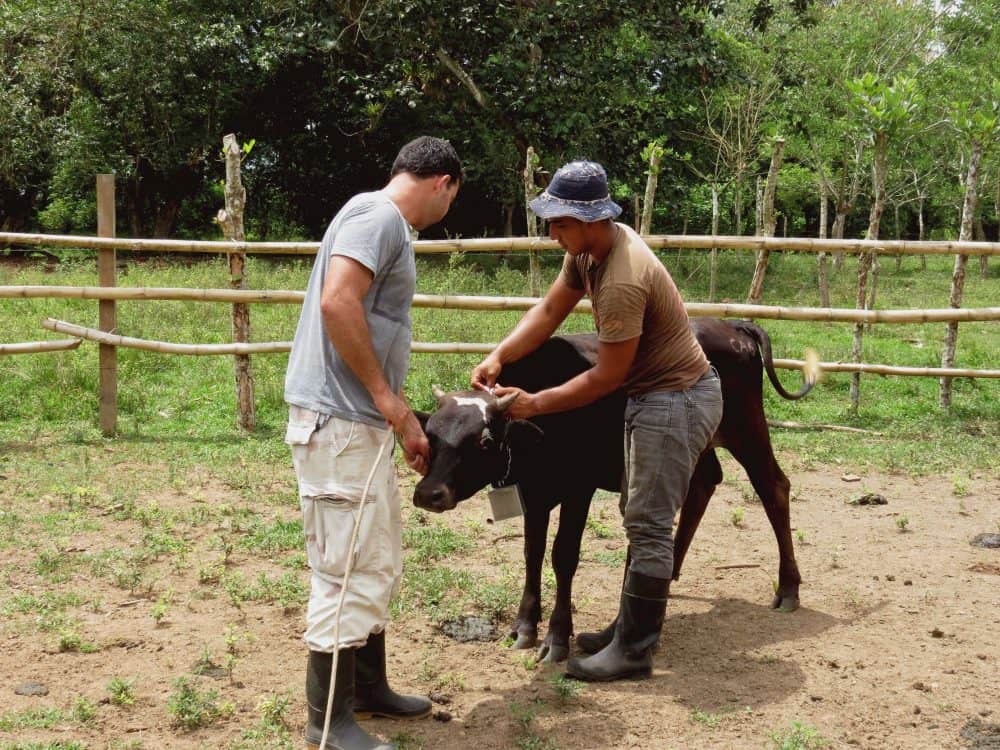
José Manuel Quirós, left, head of a wildcat conflict unit in Huetar Norte, helps a farmer affix a cowbell in Guatuso. (Courtesy José Manuel Quirós)
Costa Rican conservation officials often receive calls from local
farmers that sound something like this: “They killed two of my calves.
Come trap this cat.” Wildcat attacks on livestock are a recurring problem in rural Costa
Rica, and they often lead to the death of endangered wildcat species.
Pumas and jaguars are killing farmers’ cattle, sheep, horses and
dogs. Landowners often retaliate by either poaching the cats or allowing
other hunters on their forested property.
To address the conflict and help reduce wildcat and livestock
killings, the National System of Conservation Areas, or SINAC, began a
new program last September that created specialized units to respond to
the conflicts. The units, called Unidades de Atención de Conflictos con
Felinos in Spanish, or UACFel, are the result of an agreement between
SINAC and the conservation group Panthera. In less than a year, the
units have helped prevent attacks on at least 20 farms, officials said.
Under the program, SINAC officials immediately respond to reports of
wildcat attacks on farms. They determine if pumas or jaguars were
involved, then fill out a report with suggested corrective measures.
Those measures primarily focus on livestock management, construction
and repair of corrals and water troughs, installation of electric
fences, the use of cowbells, and the addition of donkeys or water
buffalos – animals that frighten wildcats and help keep them away.
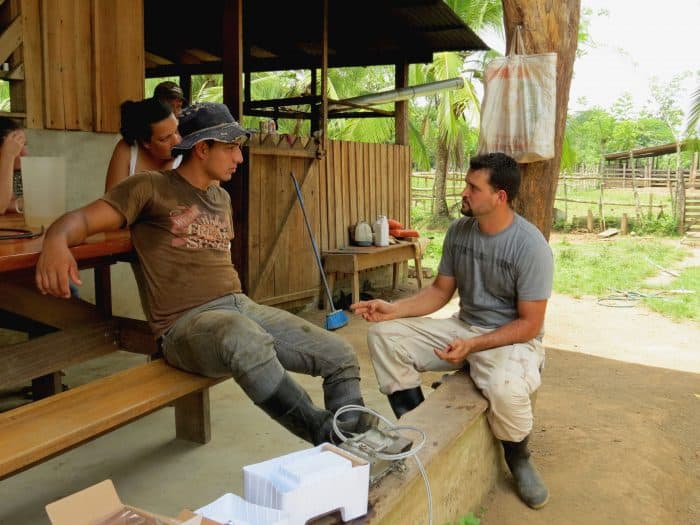
José Manuel Quirós, right, head of a wildcat response unit in Huetar Norte, chats with a farmer in Guatuso. (Courtesy José Manuel Quirós)
According to SINAC, in the Huetar Norte Conservation Area, 20 wildcat
attacks were reported from 2008 to 2013 in La Palma de Fortuna, La
Castelmare de Pital, El Concho de Pocosol, El Trapiche en Caño Negro,
Pueblo Nuevo de Zarcero, Bajos del Toro Amarillo, Buena Vista en Guatuso
and Finca Costa Ana.
In the La Amistad-Pacífico Conservation Area, eight attacks were
reported from 2010 to 2013 at Hotel Paraíso del Quetzal, Páramo, Pérez
Zeledón, Durika and Canaan de Rivas.
Panthera has different data than SINAC showing that from 2009 to
2012, Huetar Norte reported 11 attacks, the Cordillera Volcánica Central
reported 17, La Amistad-Pacífico 13 and Tortuguero 10.
Roberto Salom Pérez, Panthera’s Costa Rica director, said that before
the UACFel agreement, SINAC officials had difficulty responding to
attacks, due to a lack of time, resources and specialized training.
Panthera now offers training to conservation officers.
“What was happening is that ranchers were taking matters into their
own hands, and it usually ended with the killing of a wildcat,” Salom
said.
UACFel units currently operate in nine of Costa Rica’s 10
conservation areas. Only the Tempisque region does not yet have units,
but there are plans to create them, Yocelin Ríos Montero, who works in
SINAC’s wildlife management directorate, told The Tico Times.
SINAC officials have received two training workshops so far, the most
recent in May in Sarapiquí, during the International Symposium for the
Conservation of Wildcats in America.
Since last September, the units have received more than 40 reports of
attacks, via telephone or social media networks, Daniel Corrales, a
Panthera wildcat conflict management expert, said.
When an alert is received, a SINAC official immediately visits the
area of the attack to gather information, take photos and talk with
local residents. A report is filed that provides analysis and a
suggested strategy for farmers.
“We negotiate with livestock owners. It’s not about imposing
anything. We give farmers one or two options that can benefit them and
help reduce the vulnerability of their animals,” Corrales said.
“If animals are kept by a forested area with a water source, they
have to enter the forest to drink, and that’s where wildcats live,” he
added.
One suggested change is to place water troughs inside the farm so
that cattle and other animals don’t have to enter the forest to drink.
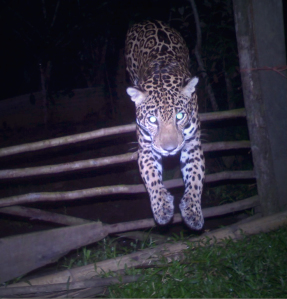
A camera trap in Barra del Pacuare captures the moment of a farm attack.
(Courtesy Earl Junier, Rolando Thompson and Ever Urbina)
Panthera and the SINAC units do not offer farmers financial
compensation for lost animals. However, they do help pay for farm
upgrades to prevent future attacks.
“The focus we’re trying to implement is an investment in improving
farms. Farmers pay part of it and we pay another part. That helps
guarantee that future attacks will be few or none,” Salom said.
Another improvement farmers can make is the building of nighttime
stables for animals, Corrales said. Panthera often pays the cost of some
building materials, such as nails, zinc laminates and wire, and farmers
provide wood, usually already available on the property.
Other suggested additions include electric fences and stables for
recently born calves with barbed wire and motion detectors. Cowbells,
which help sound the alarm when other animals are nearby, cost only
¢4,500, or $9.
Panthera also has donated four camera traps for each conservation
area, which help to determine what type of wildcat is in the area. Each
camera costs approximately $220.
On average, a total of $254 is spent on improvements at each farm.
Corrales said that since 2010, Panthera’s efforts have helped prevent repeat attacks on 20 farms.
One of the primary causes of wildcat attacks on livestock is a lack
of natural prey in the forest. According to Salom, reforestation efforts
are underway to restore habitats, and Panthera signs agreements with
farmers who promise not to allow hunting on their property.
“We know that [hunting] is one of the primary reasons that wildcats are hungry and look for anything they can find,” Salom said.
But for the units to continue functioning, SINAC and Panthera must secure long-term funding, Salom added.
July 4 is National Wildcat Day in Costa Rica, and according to Ríos,
to mark the day this year, officials anticipate the signing of an
executive decree that officially recognizes UACFel units and offers a
long-term strategy to help save jaguars and pumas.
Calls for big cat adverts to be taken off internet
08-06-2014 Martin Croucher, The National, United Arab Emirates, Dubai
DUBAI // Animal rights activists are calling on internet regulators to block access to classified websites that host advertisements selling tigers, lions and cheetahs.The Middle East Animal Foundation has approached the Ministry of Environment and Water with a list of Dubai-based sites that host adverts selling anything from jaguars to Siberian tigers.
While it is illegal to buy or sell animals without the correct paperwork, it is not clear what the rules are with regards to hosting the adverts. Site owners have previously claimed they are not doing anything wrong.
“If there isn’t already a law, there certainly should be,” said Debbie Spalton, from the MEAF.
“If it’s illegal to sell without the correct documentation, surely the website that is hosting these adverts must, by definition, also be breaking laws. I don’t see how they can’t be.”
Last year, a survey carried out by the International Fund for Animal Welfare (Ifaw) showed 796 live animal advertisements posted on 11 websites.
None included documentary proof that those who placed them were complying with the law, while only 20.7 per cent of the ads said the necessary documents were available.
Certificates from Cites, the Convention on International Trade in Endangered Specis, without which buying and selling animals is illegal, are issued by the Ministry of Environment and Water, and are issued only for legitimate breeding needs.
However, many adverts on sites claim that animals do have paperwork, although there are no photographs to prove it.
One advert on Dubailocalads.com, was offering cheetah, jaguar, white lion and tiger cubs for Dh3,000 each. The cubs were said to be “home raised” and from the third generation in captivity.
“They are potty trained and have all papers,” the advert said. “They do love the company of kids and other pets.”
The site administrators did not respond to a request for comment.
Another site, Dubai Moon Souq, has only one advert for an endangered species, a white tiger cub, for sale for Dh9,000. The owner of that site told The National two years ago that he was not aware that hosting adverts was wrong.
“If this is not allowed to be sold, we need someone from the municipality or the police to come and tell us this,” he said at the time.
The local office of Cites has described the advertising of animals online as a legal “grey area”.
In February, the UAE ratified the London Declaration on Wildlife Trade, which was hoped would bring about tougher rules on the online sale of big cats.
The ministry was unavailable for comment on what specific steps it was planning to take.
However, Dr Elsayed Mohammed, the Middle East regional director of Ifaw, said earlier this year he was aware of the authority drafting new rules in this respect.
Ms Spalton said animals such as tigers or lions currently being kept by private individuals should be rescued and given to a proper breeding programme.
“They belong in the wild,” she said. “They don’t belong in a cage to be let out on party night at the weekend and shown off to the neighbours.
“They’re not a gimmick, nor should they be ridden like a horse,” she said, referring to pictures of a Gulf national riding on the back of a lion that circulated on social media recently.
“It’s a death sentence for an animal. When they get older, they get out of control. Suddenly they’re not cute cubs to be put in the back of a Lamborghini.
“A lot of them end up in a sad situation and some of them get put down, because their owners can’t handle them any more.”
Paramaribo -Tussen 2010 en 2014 zijn wereldwijd jaarlijks enkele tientallen
jaguars legaal verhandeld, vooral tussen dierentuinen onderling.
Daarnaast blijken zelfs exemplaren te zijn geëxporteerd met als
eindbestemming een circus…. Dat blijkt uit de handelsdatabase van CITES
(Convention on International Trade in Endangered Species of Wild Fauna
and Flora). Uit die database blijkt ook dat een Surinaamse jaguar in
2012 in een dierentuin in Turkije belandde. Een opmerkelijke export. Een
export waarover betrokken instanties en de mogelijk ontvangende
dierentuin in Turkije het zwijgen toe doen.
Zelden
wordt een jaguar vanuit een land geëxporteerd waar het dier zijn
habitat heeft. De afgelopen vier jaar zijn alleen jaguars geëxporteerd
naar of geïmporteerd uit een land waar het dier in het wild leeft:
- Guatemala (dat in 2011 twee jaguars exporteerde naar Honduras),
- Colombia*,
- Mexico (in 2011 exporteerde dit land drie jaguars naar de Dominicaanse
Republiek en in 2010 werden al twee jaguars naar de Dominicaanse
Republiek vervoerd, alleen voor een dierentuin, een exemplaar werd
geëxporteerd naar Guatemala en een naar Panama, er werd zelfs een jaguar
uit de VS geimporteerd in 2010),
- Panama en
- Suriname.
* Het is opmerkelijk, dat Colombia in 2011 een jaguar importeerde uit
Frankrijk (met als bestemming een dierentuin) terwijl het
Zuid-Amerikaanse land in 2010 een jaguar exporteerde naar Chili en in
hetzelfde jaar twee exemplaren importeerde uit Frankrijk voor een
dierentuin.
De staartloze jaguar in de Paramaribo Zoo. (Bron foto: eigen foto Kraaijer)
Suriname zwijgt over export
Suriname heeft tussen 1975 (het jaar dat CITES startte met haar
handelsdatabase) en 2014 slechts eenmaal een jaguar geëxporteerd en dat
was vrij recent, in 2012, naar een dierentuin in Turkije. Het blijkt
echter bijzonder lastig om te achterhalen door wie of wat de jaguar in
2012 werd geëxporteerd uit Suriname en wat de eindbestemming was, welke
Turkse dierentuin. Dat land heeft feitelijk twee grote dierentuinen waar
ook jaguars worden gehouden, te weten de Ankara Zoo in Ankara en de Gaziantep Zoo
in Gaziantep. De dierentuin in de stad Gaziantep zou de vierde grootste
dierentuin ter wereld zijn met zo’n 4.000 dieren verdeeld over 270
soorten.
Beide dierentuinen reageerden niet op herhaalde verzoeken om te
antwoorden op de vraag of zij wellicht een jaguar uit Suriname in 2012
hebben ontvangen.
Bij de export betrokken instanties in Suriname waren eveneens niet
bereikbaar voor een reactie, ondanks herhaalde verzoeken, zoals de twee
officiële contacten van CITES in Suriname te weten het hoofd van de
dienst ‘s Lands Bosbeheer (‘Management Authority’) en de zogenoemde
Natuurbeschermingscommissie binnen de dienst ‘s Lands Bosbeheer
(‘Scientific Authority’).
Ook de Douane Suriname hult zich in stilzwijgen.
Kennelijk wil of kan geen van genoemde instanties de vragen beantwoorden
wie of wat de jaguar in 2012 heeft geëxporteerd en naar welke
dierentuin in Turkije.
De export is opmerkelijk, omdat Suriname hiermee een van de weinige
landen is waar de jaguar in het wild leeft en dat een exemplaar de
laatste jaren heeft geëxporteerd. De vraag kan gesteld worden, waarom
die ene Surinaamse jaguar bijvoorbeeld niet terecht is gekomen in de
lokale Paramaribo Zoo. Daar bevindt zich immers slechts een jaguar en
die mist nota bene zijn staart…. Hieronder ter informatie een overzicht uit de jaren 2013, 2012, 2011 en 2010 van de wereldwijde handel, export, in jaguars. 2013
In dat jaar is er sprake van slechts vier verhandelde, geëxporteerde,
jaguars. Belarus importeerde twee jaguars uit Georgië voor een
dierentuin. Ook werd een exemplaar geïmporteerd uit Rusland en een uit
de Ukraine, beide bestemd voor een circus…..! Volgens CITES kwamen de
vier door Belarus geïmporteerde jaguars oorspronkelijk ook uit
Belarus….. Dus via een omweg (Georgië, Rusland en Ukraine) keerden de
vier jaguars weer terug in hun oorspronkelijke land van herkomst,
Belarus. 2012
Eenentwintig jaguars werden in totaal in 2012 door diverse landen
geëxporteerd. In geen van die landen komt het dier in het wild voor.
Opvallend is, dat enkele landen een jaguar blijken te hebben
geëxporteerd om vervolgens een exemplaar te importeren:
België importeerde drie jaguars uit Griekenland en de handelsdatabase
van CITES vermeldt als doel van de export, commerciële doeleinden.
De Verenigde Arabische Emiraten importeerde drie jaguars uit België (!)
met als bestemming ‘privé’ (zouden dat de door België uit Griekenland
geïmporteerde dieren zijn geweest?), twee jaguars uit Spanje ook met als
doel ‘privé’ en een ander exemplaar uit Spanje voor zogenoemde
commerciële doeleinden.
Azerbeidzjan importeerde een jaguar uit Letland (oorspronkelijke
herkomst Rusland) voor een circus. Het Baku Staats Circus van dat land
blijkt inderdaad jaguars in haar show te hebben.
Belarus liet twee jaguars uit Rusland importeren voor een dierentuin.
Japan importeerde een jaguar uit Polen met als eindbestemming een dierentuin.
Letland importeerde een exemplaar uit Rusland voor een circus (let wel,
Letland exporteerde in hetzelfde jaar een jaguar naar Azerbijan…..).
Saoedi Arabië importeerde in 2012 twee jaguars respectievelijk uit
Frankrijk en Griekenland en beide hadden als bestemming een dierentuin.
Thailand importeerde een jaguar uit Zuid-Afrika, voor een dierentuin,
terwijl laatst genoemd land een jaguar importeerde uit Zambia, terwijl
dat dier oorspronkelijk afkomstig was uit Frankrijk, met als doel
educatie.
Turkije importeerde een jaguar uit Suriname, ook voor een dierentuin.
Suriname was het enige land in 2012, en sowieso de laatste jaren een van
de weinige landen, waar de jaguar in het wild voorkomt dat een
exemplaar exporteerde. 2011
Dit jaar werden in totaal drieëndertig jaguars wereldwijd verhandeld onder CITES-regelgeving:
China importeerde twee jaguars uit Spanje, bestemd voor een dierentuin.
Colombia, een land waar de jaguar zijn habitat heeft, importeerde een
exemplaar uit Frankrijk, dat oorspronkelijk afkomstig was uit Spanje,
voor een dierentuin.
De Dominicaanse Republiek importeerde drie jaguars uit Mexico voor een dierentuin.
Hongkong importeerde een jaguar uit Zuid-Afrika voor een fokprogramma.
Honduras importeerde in 2011 twee exemplaren uit Guatemala met als doel wetenschap. In beide landen leeft de jaguar in het wild.
Indonesië haalde drie jaguars uit het buitenland waarvan twee uit
Duitsland en een uit de Tsjechische Republiek, allen met als bestemming
een dierentuin. De jaguar uit de Tsjechische Republiek kwam overigens
oorspronkelijk uit Hongarije.
Japan importeerde twee jaguars voor een dierentuin uit respectievelijk Canada en China.
Kazachstan importeerde twee exemplaren uit respectievelijk Kirgizië en Rusland voor een circus.
Thailand importeerde twee jaguars uit Zuid-Afrika voor een dierentuin,
terwijl Zuid-Afrika in 2012 maar liefst vijftien exemplaren importeerde
waarvan twee uit de Verenigde Arabische Emiraten voor een
‘fokprogramma’, twee uit België (met als oorspronkelijk land van
herkomst Duitsland) voor commerciële doeleinden en twee uit België voor
een dierentuin, een exemplaar uit Frankrijk voor educatie, acht dieren
uit Mexico waarvan vier voor een fokprogramma en vier voor een
dierentuin. 2010
Zesendertig jaguars verruilden de ene internationale bestemming voor de andere internationale bestemming in 2010:
De Verenigde Arabische Emiraten importeerde twee exemplaren waarvan
een uit Duitsland (voor een fokprogramma) en een uit Marokko met als
bestemming een dierentuin. Het importerende land, Verenigde Arabische
Emiraten, exporteerde in hetzelfde jaar een jaguar voor een fokprogramma
naar Armenië.
Colombia exporteerde een jaguar naar Chili voor een dierentuin en
importeerde twee exemplaren, voor een dierentuin, uit Frankrijk, terwijl
een van die twee dieren van oorsprong afkomstig was uit Spanje.
De Dominicaanse Republiek importeerde twee jaguars uit Mexico bestemd voor een dierentuin.
Guatemala importeerde eveneens uit Mexico een jaguar voor een fokprogramma’.
Honduras importeerde zeven jaguars uit El Salvador (de handelsdatabase van CITES vermeldt hierbij niet het doel van de export).
Twee jaguars werden door Indonesië geïmporteerd uit respectievelijk de
Tsjechische Republiek (de jaguar kwam oorspronkelijk uit Hongarije) en
Rusland, beide voor een dierentuin.
Japan importeerde een jaguar uit Canada, voor een dierentuin.
Mexico importeerde een jaguar voor een dierentuin uit de VS, terwijl het dier oorspronkelijk uit Mexico afkomstig was……
Panama liet een jaguar overkomen uit Mexico voor een dierentuin.
Thailand importeerde vier exemplaren voor een dierentuin, waarvan twee
uit Canada en een uit Namibië, terwijl de jaguar uit Namibië
oorspronkelijk uit Zuid-Afrika kwam.
Turkije importeerde twee jaguars uit Frankrijk waarvan een voor een dierentuin en een voor commerciële doeleinden.
Trinidad & Tobago importeerde uit de VS, voor een dierentuin, drie jaguars.
Zuid-Afrika importeerde in 2010 vier jaguars, waarvan twee uit Belgie
(voor commerciële doeleinden – dit dier heeft als origine Frankrijk – en
een dierentuin), een uit de Tsjechische Republiek (voor een
fokprogramma) en een uit Frankrijk voor educatieve doeleinden. Suriname uitzondering: export van in het wild gevangen jaguar
Uit het voren gaande moge blijken dat er toch een aanzienlijke
internationale handel in de bedreigde jaguar is en dat veel van die
handel plaatsvindt tussen dierentuinen onderling. Maar, opmerkelijk zijn
ook de paar exporten van jaguars die als eindbestemming een circus
hadden… Kennelijk valt er veel geld te verdienen aan deze handel. Dat
blijkt ook uit het feit, dat er landen zijn die in een jaar tijd zowel
een jaguar importeren als exporteren……
Uit de CITES handelsdatabase wordt ook duidelijk dat er nauwelijks wordt
gehandeld in in het wild gevangen exemplaren en dat Suriname de
afgelopen negenendertig jaren slechts eenmaal, legaal, een panthera onca
ofwel een ‘tigri’, zoals de jaguar in Suriname veelal wordt genoemd,
heeft geëxporteerd. De zwijgzaamheid van alle bij die export betrokken
instanties is overigens opmerkelijk…… Wat mag de Surinaamse burger niet
weten over deze export?
Jaguar babies in Palm Desert | Photo: The Living Desert
We pride ourselves on hard-hitting analysis of wildlife issues here at ReWild, but sometimes a person just has to kick back and gawp over cute zoo babies... in this case, two baby jaguars born recently at The Living Desert, a popular desert-themed zoo and garden in the Coachella Valley.
The cubs were born April 26 to four-year-old mom Magia in a specially prepared, secluded den. The cubs won't be on public display for several months. First-time jaguar mothers sometimes abandon or injure their young if they're spooked, so Magia and the kids are being given all the privacy they need for the time being, attended by just two zoo staff. "We are being very cautious with this 'first time' mother and want to give her the time she needs before we allow staff near," said The Living Desert CEO Allen Monroe.
But that doesn't mean we can't get a glimpse of the babies: The Living Desert has posted a bit of video online, along with some baby pictures.
In this minute-long video, you can see Magia trying to encourage her curious cubs to come back into the den away from the prying eyes of the Internet:
Those adorable little cubs with their utterly bitable ears will grow into adult members of the world's third-largest cat species, after tigers and lions. Jaguars, Panthera onca, are the largest cat species in the Americas, and the largest predatory mammal of any kind through most of their remaining range in South America.
These aren't the first jaguar cubs to be born in the Palm Desert area: until the late 19th century, the nearby Santa Rosa and San Jacinto mountains held populations of the big cats, which roamed California as far north as Monterey. Though there have been highly publicized jaguar sightings in southern Arizona in recent years, the sad story of Macho B being a prime example, many authorities consider the animal extinct in the United States.
Though the cats are faring somewhat better in the southern parts of their range, the same pressures that drove them to extinction in the U.S. are working to reduce their numbers elsewhere.
Deforestation, targeting by ranchers seeking to protect their livestock, and poaching for the fur trade have pushed jaguars out of much of their range from Mexico to Argentina. Strongholds for the species remain in the Amazon Basin and the Andes, but the cats are under enough pressure that international trade in their skins is completely banned.
Jaguars were listed as Endangered under the U.S. Endangered Species Act in 1997, and the U.S. Fish and Wildlife Service designated about 1,200 square miles of Southern Arizona and New Mexico as critical habitat for the cats, in case any more of them make it past the increasingly wildlife-unfriendly border.
So, reason to celebrate: two more jaguars in the world, albeit captive ones. The as-yet unnamed cubs will be weaned in around two months, and will get their first glimpses of desert zoo visitors some time after that.
Until Magia and the cubs make their way out into the public view, you can always visit their father Memo, who is not being granted visitation rights due to male jaguars' regrettable tendency toward infanticide.
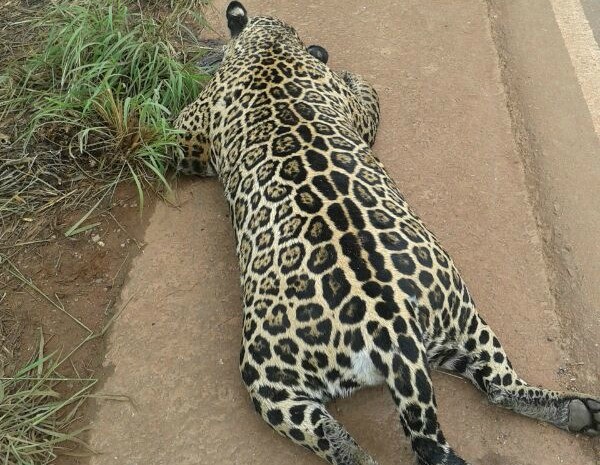
Onça foi encontrada morta à beira de estrada em Mato Grosso neste sábado (23) (Foto: Leilson Vieira/Arquivo pessoal)
Uma onça foi encontrada morta à beira de uma estrada estadual de Mato Grosso,
entre os municípios de Jangada e Barra do Bugres.
O animal tinha
aproximadamente 1,20m, segundo o tenente do Corpo de Bombeiros Leilson
Vieira, que viu o felino morto na MT-246 por volta das 9h deste sábado
(24).
Vieira disse acreditar que a onça tenha sido atropelada por um veículo
de grande porte. "Tinha marcas de frenagem na pista que parecia ser de
uma carreta ou caminhão".
Segundo o tenente, o animal aparentava ser
adulto e devia pesar, pelo menos, 200 quilos.
Note: Last
Saturday (24 May), a 3,9-feet long jaguar was found dead on the side of
the road MT-246, in the state of Mato Grosso, Brazil. Braking marks on
the road indicate that the feline was hit by either a truck or a tractor
trailer. The question remains: Until when will we have to wait for this
crucial - and frequent - problem to be properly addressed by the
Brazilian authorities?
The Costa Rica News (TCRN) – Over the weekend, specialists and
researchers of Felines in the Americas gathered to teach and participate
in conferences, workshops, tours and exploration excursions and to
analyze the state of conservation of cat species on the continent.
From May 23 to 26, 2014 the first International Symposium of
Conservation of Cats in America, was held in Sarapiqui, Costa Rica, in
the primary rainforest reserve Selva Verde Lodge in Sarapiqui, the
lowlands of the Atlantic slope of Costa Rica.
The symposium featured
presentations, posters, and the participation of organizations for the
research, conservation and knowledge of cats. Additionally, research
results and developments that are taking place in America were
announced.
Worldwide there are 37 species of cats, 12 of them present in the
American continent, 6 of them live in Costa Rica. Due to its
geographical position and its isthmus status between North America and
South America, Costa Rica is a key link in the conservation of these
great animals.
The International Symposium on Conservation of Cats in America, aimed
to be a forum for discussion, exchange of knowledge and to strengthen
efforts to preserve these magnificent mammals in America.
Experts from more than 15 countries in America and Europe were
present at this great conservation event, where over 30 conferences and
discussions were presented.
Parallel to the symposium, Panthera and SINAC (National System of
Conservation Areas) continues training a group of AFE officials that
make up Care Unit Conflicts with Felines (UACFel) to facilitate
coexistence between cats and cattle in Costa Rica.